信息通信技术与政策

信息通信技术与政策

信息通信技术与政策 ›› 2026, Vol. 52 ›› Issue (4): 30-38.doi: 10.12267/j.issn.2096-5931.2026.04.004

专题:低空经济 上一篇    下一篇

面向低空安全的C-V2X协同避让技术:需求、架构与展望*

C-V2X collaborative collision avoidance technology for low-altitude safety: requirements, architecture and prospects

习一凡1,2, 胡金玲1,2, 赵锐1,2, 房家奕1,2   

  1. 1.中信科智联科技有限公司, 北京 100029
    2.移动通信及车联网国家工程研究中心, 北京 100191
  • 收稿日期:2026-03-12 出版日期:2026-04-25 发布日期:2026-04-24
  • 通讯作者: 胡金玲 中信科智联科技有限公司、移动通信及车联网国家工程研究中心首席专家,教授级高级工程师,主要研究方向为车联网与下一代无线通信等
  • 作者简介:
    习一凡 中信科智联科技有限公司、移动通信及车联网国家工程研究中心标准研究工程师,主要研究方向为车联网无线通信技术等
    赵锐 中信科智联科技有限公司、移动通信及车联网国家工程研究中心高级标准专家,教授级高级工程师,主要研究方向为车联网无线通信技术等
    房家奕 中信科智联科技有限公司、移动通信及车联网国家工程研究中心标准总监,教授级高级工程师,主要研究方向为车联网通信、车路协同等技术及标准化
  • 基金资助:
    *国家自然科学基金资助项目(62133002)

XI Yifan1,2, HU Jinling1,2, ZHAO Rui1,2, FANG Jiayi1,2   

  1. 1. CICT Connected and Intelligent Technologies Co., Ltd., Beijing 100029, China
    2. National Engineering Research Center of Mobile Communications and Vehicular Networks, Beijing 100191, China
  • Received:2026-03-12 Online:2026-04-25 Published:2026-04-24

摘要:

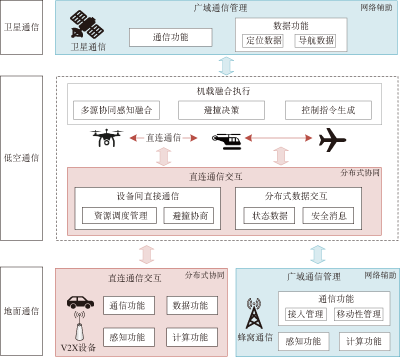
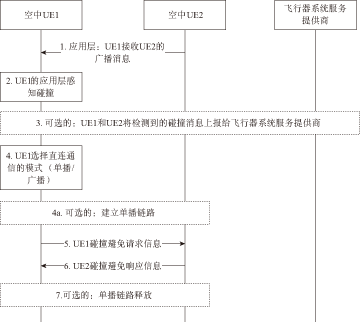
随着低空经济快速发展,飞行器高密度运行对避让能力提出严苛要求。针对低空协同避让的通信需求,提出基于蜂窝车联网(Cellular Vehicle-to-Everything,C-V2X)邻近直连通信接口5(Proximity-services Communication 5,PC5)的体系架构,包含直连通信交互层、广域通信管理层和机载融合执行层;分析了典型低空场景与通信性能要求,阐述了核心使能技术及标准化协同避让交互流程;最后展望了三维波束管理、智能干扰协调和频谱政策等未来研究方向,为低空安全通信系统构建提供理论参考。

关键词: 低空安全, 协同避让, 直连通信

Abstract:

With the rapid development of the low-altitude economy, the high-density operation of aircraft has imposed stringent requirements on collision avoidance capabilities. Aiming at the communication requirements for low-altitude collaborative collision avoidance, this paper proposes a system architecture based on Cellular-Vehicle-to-Everything (C-V2X) Proximity-services Communication 5 (PC5) sidelink communication, which consists of the sidelink communication interaction layer, the wide-area communication management layer, and the on-board fusion execution layer. Typical low-altitude scenarios and corresponding communication performance requirements are analyzed. The core enabling technologies and the standardized collaborative collision avoidance interaction process are elaborated. Finally, future research directions such as 3D beam management, intelligent interference coordination, and spectrum policy are discussed, providing a theoretical reference for the construction of low-altitude safety communication systems.

Key words: low-altitude safety, collaborative collision avoidance, sidelink communication.

中图分类号: