Information and Communications Technology and Policy

Information and Communications Technology and Policy

Information and Communications Technology and Policy ›› 2025, Vol. 51 ›› Issue (2): 30-39.doi: 10.12267/j.issn.2096-5931.2025.02.005

Previous Articles     Next Articles

Research on cloud service architecture and key technologies of computing center

ZHAO Xiping1,2, DING Fei1, WANG Shiyi1, WANG Rui1, WU Di1, LIU Zhishuai2   

  1. 1. National Local Joint Engineering Research Center for Communication and Network Technology, Nanjing University of Posts and Telecommunications, Nanjing 210003, China
    2. China Mobile (Suzhou) Software Technology Co., Ltd., Suzhou 215163, China
  • Received:2025-01-14 Online:2025-02-25 Published:2025-03-04

Abstract:

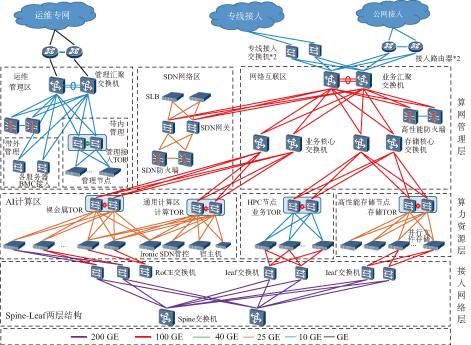
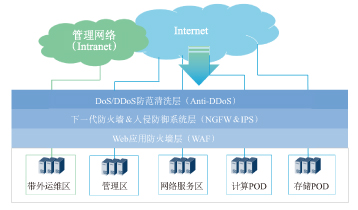
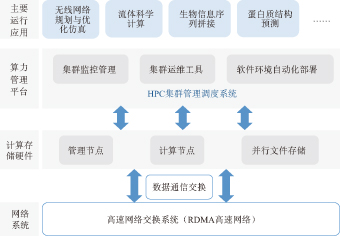
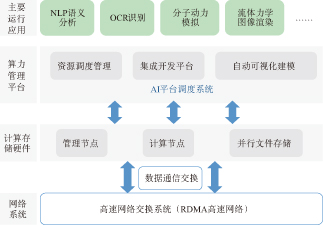
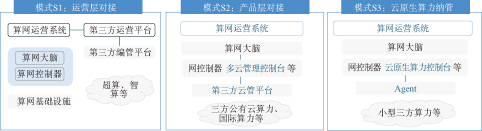
The computing power center includes large-scale hardware facilities such as servers and storage devices, providing a unified computing platform for processing complex computing tasks. How to design and implement a computing power center cloud architecture compatible with universal computing power, super computing power and intelligent computing power is a hot research direction. This paper focuses on analyzing the development and evolution trend of the research paradigm driven by education cloud, as well as the demand for computing power of different representative disciplines. And this paper gives the research progress of the industry in computing power network, supercomputing center, smart computing platform and data governance. On this basis, this paper proposes an overall network architecture of computing power center cloud, describes the basic structure, security protection and open service design of this architecture, and gives a typical docking scheme of computing power connected to the grid in cross-domain scenarios. The architecture can meet the needs of scientific computing in heterogeneous computing force management, data model concurrent training, distributed reasoning, high-performance computer simulation, and scientific research application services. Based on the flat network design of Spine-Leaf two-tier devices, integrating the platform capabilities of general computing power, super computing power, intelligent computing power and other platform capabilities, it will be able to form a new cloud service network architecture with heterogeneous integration, high-performance computing and storage, and open capabilities.

Key words: computing power centric cloud, cloud-native, high performance computing, grid connected computing power, computing power scheduling

CLC Number: