

Information and Communications Technology and Policy ›› 2026, Vol. 52 ›› Issue (10): 87-96.doi: 10.12267/j.issn.2096-5931.2026.10.011
JIA Chenglu, SUN Peng
Received:2026-08-25
Online:2026-10-25
Published:2026-10-28
CLC Number:
JIA Chenglu, SUN Peng. Performance study of AI-receiver-enabled 6G low-density DMRS[J]. Information and Communications Technology and Policy, 2026, 52(10): 87-96.
| 架构编号 | 覆盖范围 | 功能 |
|---|---|---|
| 架构1 | 基于AI的DMRS导频去噪 | AI模型仅对DMRS RE处的LS粗估计信道进行去噪处理,后续的信道插值、均衡和解调仍采用传统方法 |
| 架构2 | 基于AI的数据RE信道估计 | AI模型以DMRS处的LS估计为输入,输出精炼后的目标RE信道响应 |
| 架构3 | 基于AI的目标RE信道预测 | AI模型利用历史时隙的信道估计预测未来时隙的信道响应,适用于高速移动等快变信道场景 |
| 架构4 | 基于AI的联合信道估计、均衡和解调 | 单个AI模型同时替代信道估计、均衡和星座解调三个模块,实现端到端接收处理 |
| 架构5 | 基于AI的信道估计+基于AI的均衡和解调 | 两个AI模型分别处理信道估计、均衡和解调,模块间解耦程度高于架构4 |
| 架构6 | 信道估计+均衡+基于AI的解调 | 信道估计和均衡采用传统方法,仅将星座解调替换为AI模型 |
| 架构7 | 基于AI的信道估计+均衡+基于AI的解调 | 信道估计和解调分别采用AI模型,均衡保留传统MMSE干扰拒绝合并(Interference Rejection Combining, IRC)方法 |
| 参数 | 取值 |
|---|---|
| 频率范围/GHz | 3.5 |
| 子载波间隔/kHz | 30 |
| 波形 | CP-OFDM |
| 系统带宽(资源块数) | 12 |
| OFDM符号数 | 14 |
| 信道模型 | CDLA~E, UMi |
| 时延拓展 | {30 ns, 100 ns, 300 ns} |
| 运动速度/km/h | 0~300 |
| 基站接收天线 | 32 RX, (M, N, P, Mg, Ng, Mp, Np) = (4, 4, 2, 1, 1, 1, 1) |
| 用户发射天线 | 4 TX, (M, N, P, Mg, Ng, Mp, Np) = (4, 1, 1, 1, 1, 1, 1) |
| 预编码粒度 | 宽带 |
| 链路自适应 | 固定调制编码方案 |
| MIMO方案 | 单用户MIMO |
| DMRS频域密度 | Comb 2/4/6/8/12 |
| DMRS符号位置 | 3符号[2, 7, 11]; 2符号[2, 11] |
| MIMO层数 | {1, 2} |
| 传输块大小(Transport Block Size,TBS) | 固定TBS |
| 参数 | 架构2 | 架构6 |
|---|---|---|
| 模型结构 | Transformer | Transformer |
| 模型输入 | LS估计经线性插值后的DMRS信道估计结果 | 均衡后的星座符号 |
| 模型输出 | 精炼后的全RE信道频率响应 | LLR |
| 训练标签 | 理想信道估计 | 已知编码比特 |
| 训练方式 | 离线多场景/配置混合训练 | 离线多场景/配置混合训练 |
| MIMO层数 | 1或2 | 1或2 |
| 总计算量 | 1.9 GFLOPs/14符号/12RB/32RX/传输层 | 140 MFLOPs/14符号/12RB/传输层 |
| 总参数量 | 5.8 M | 0.02 M |
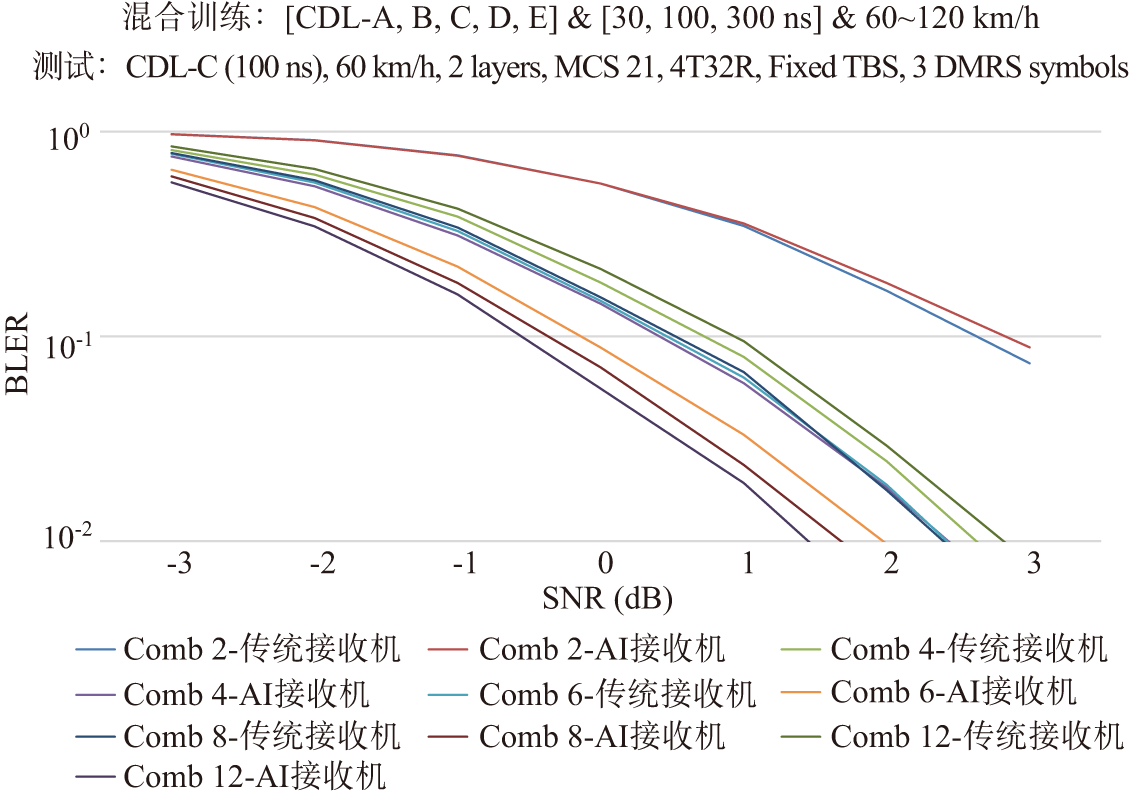
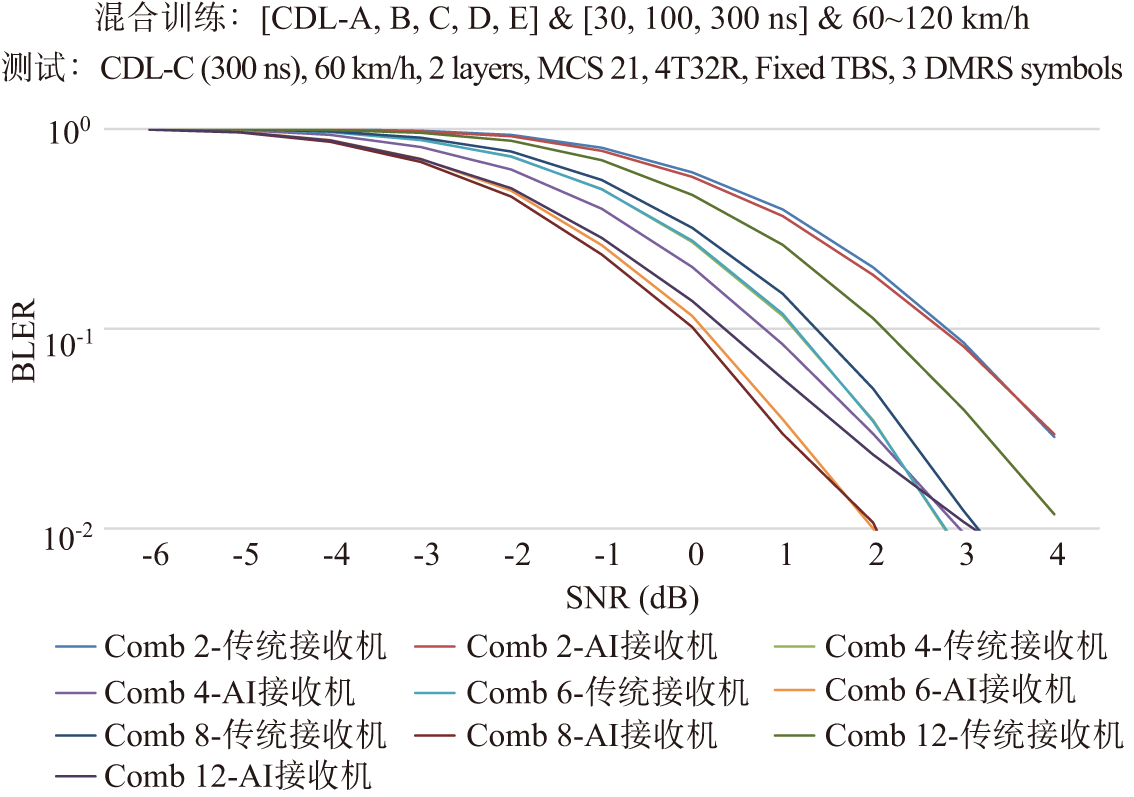
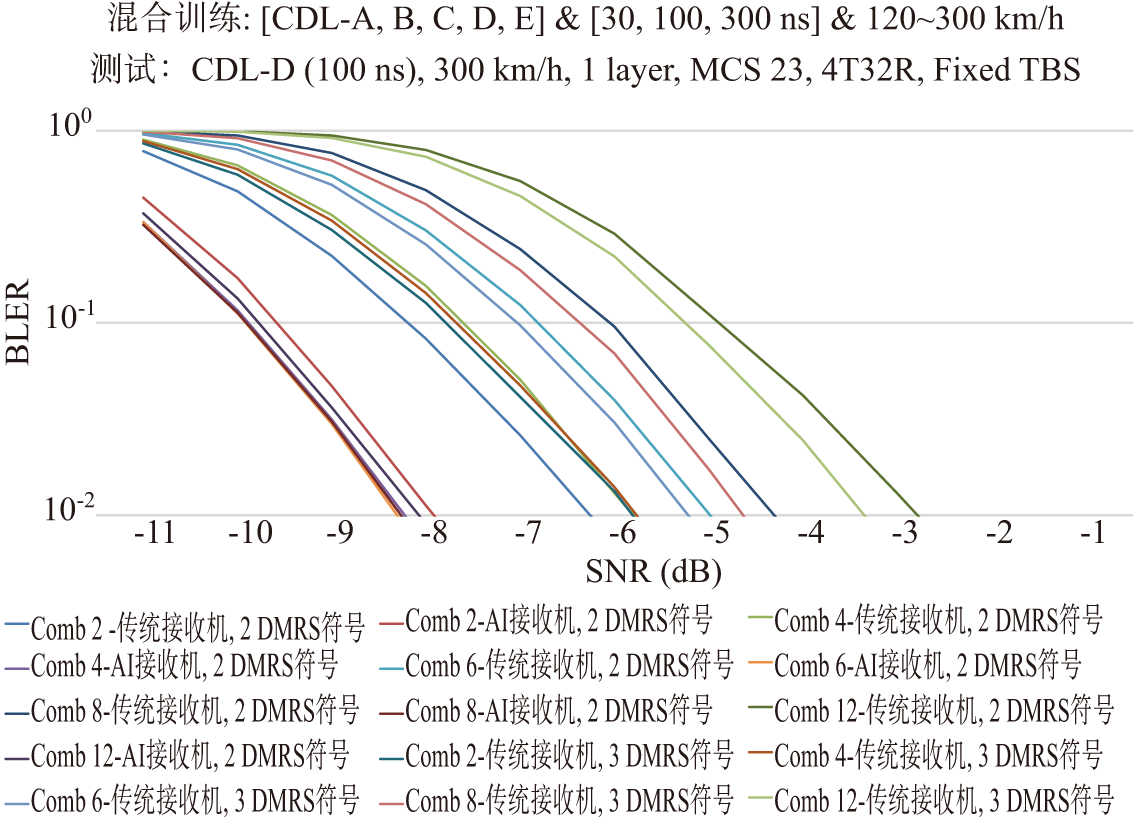
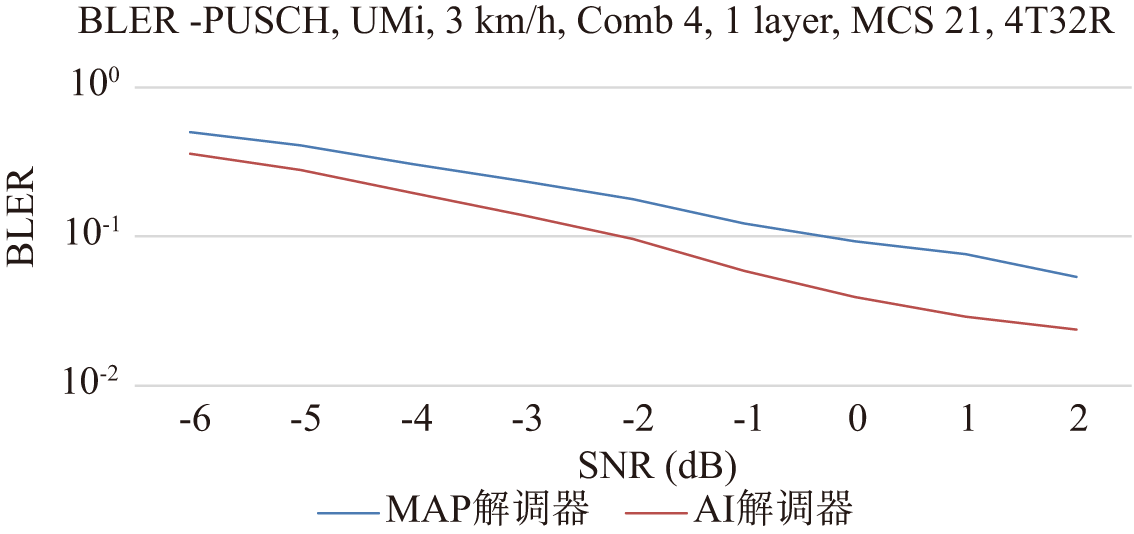
| 基线对比方案 | MMSE信道估计+MMSE-IRC均衡+ Maxlog解调 | MMSE信道估计+MMSE-IRC均衡+ MAP解调 |
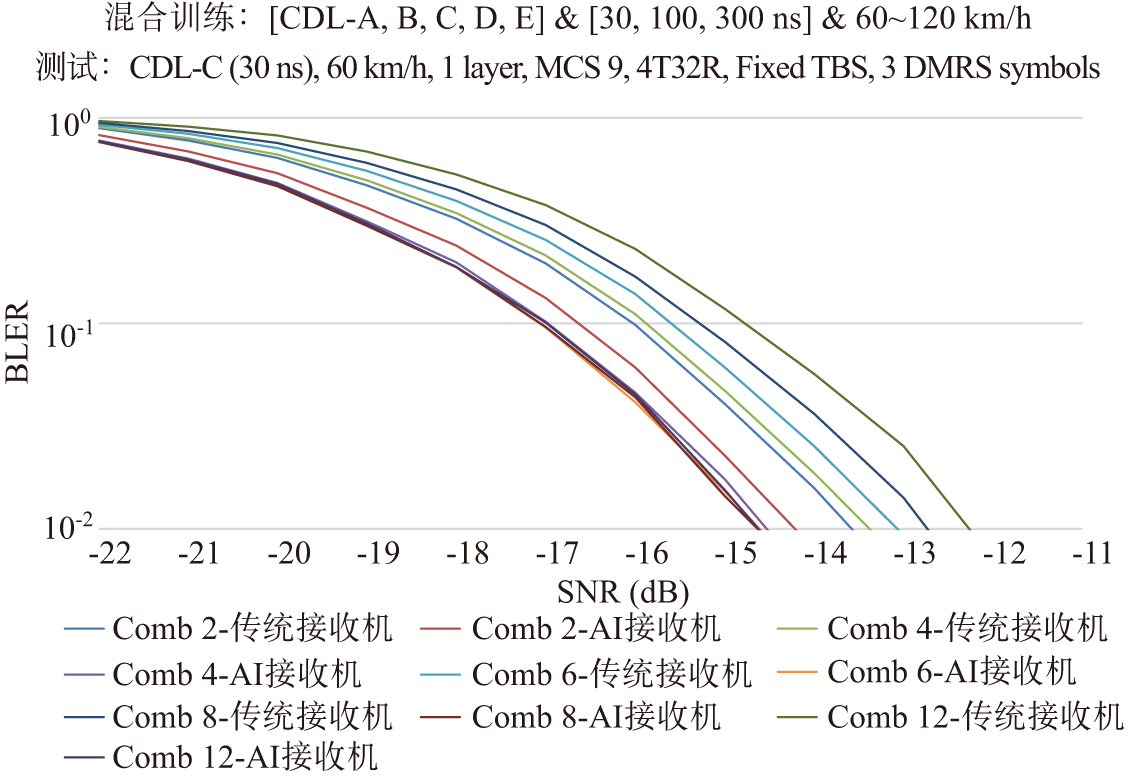
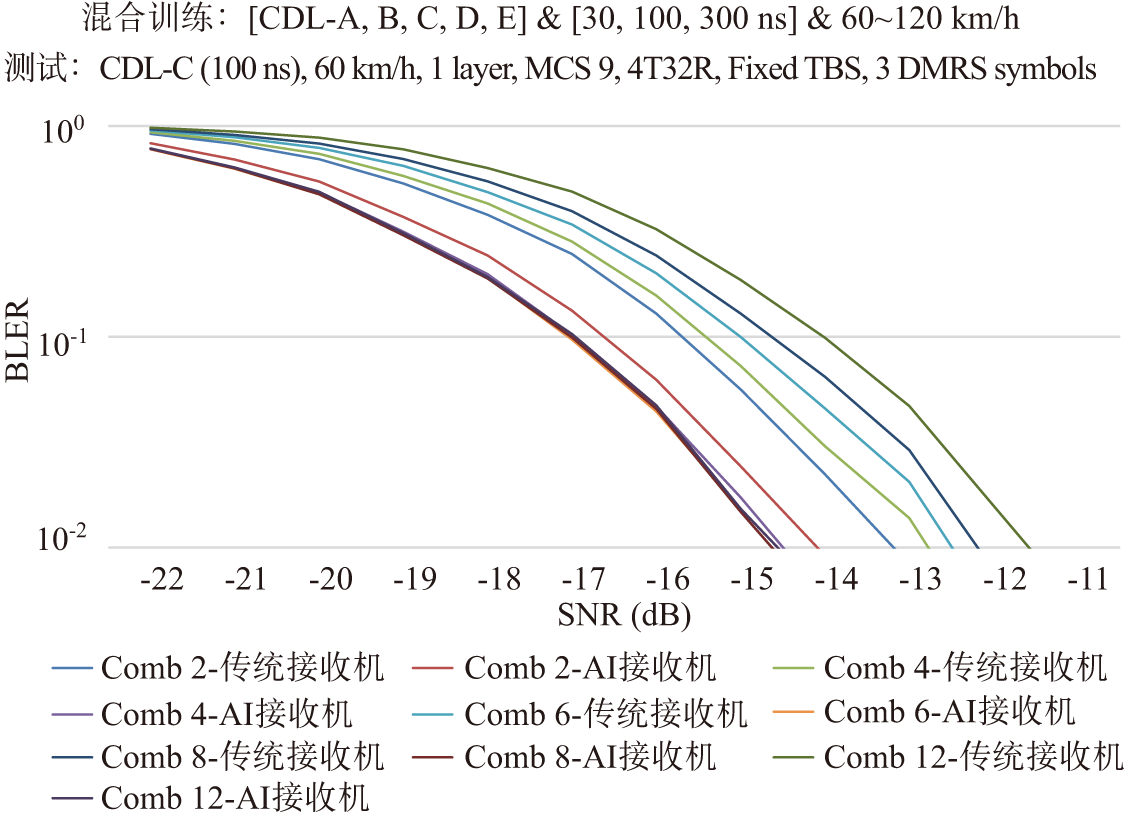
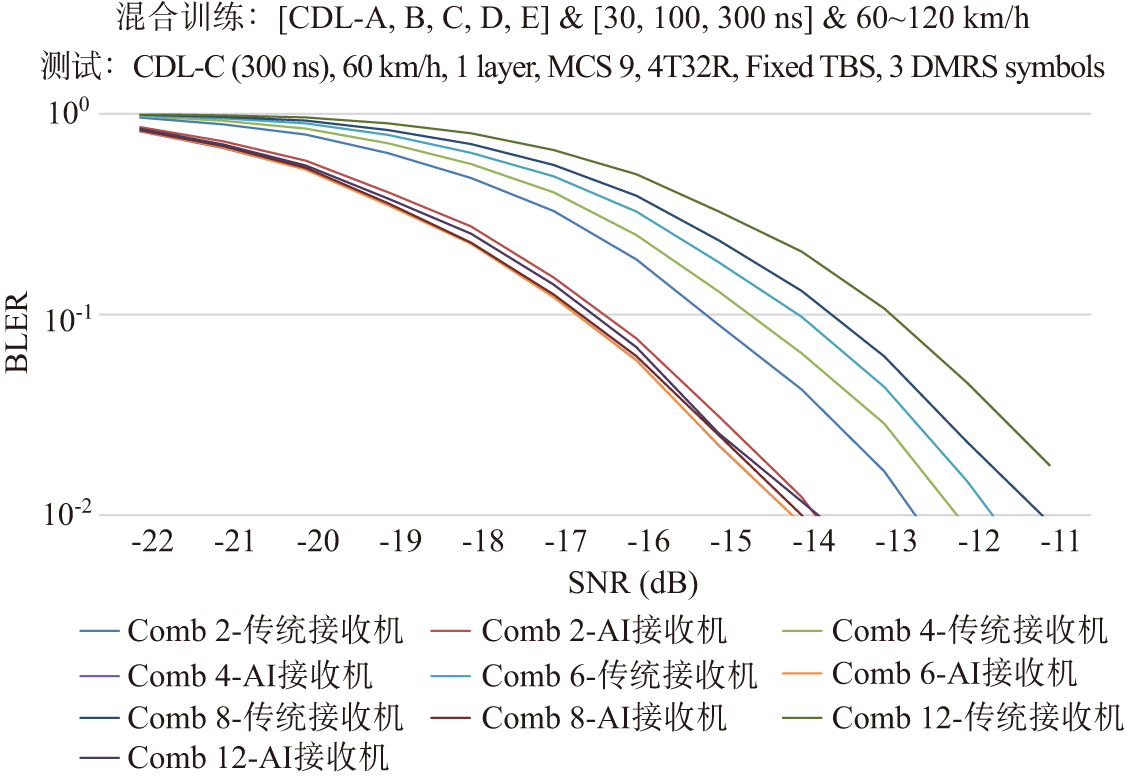
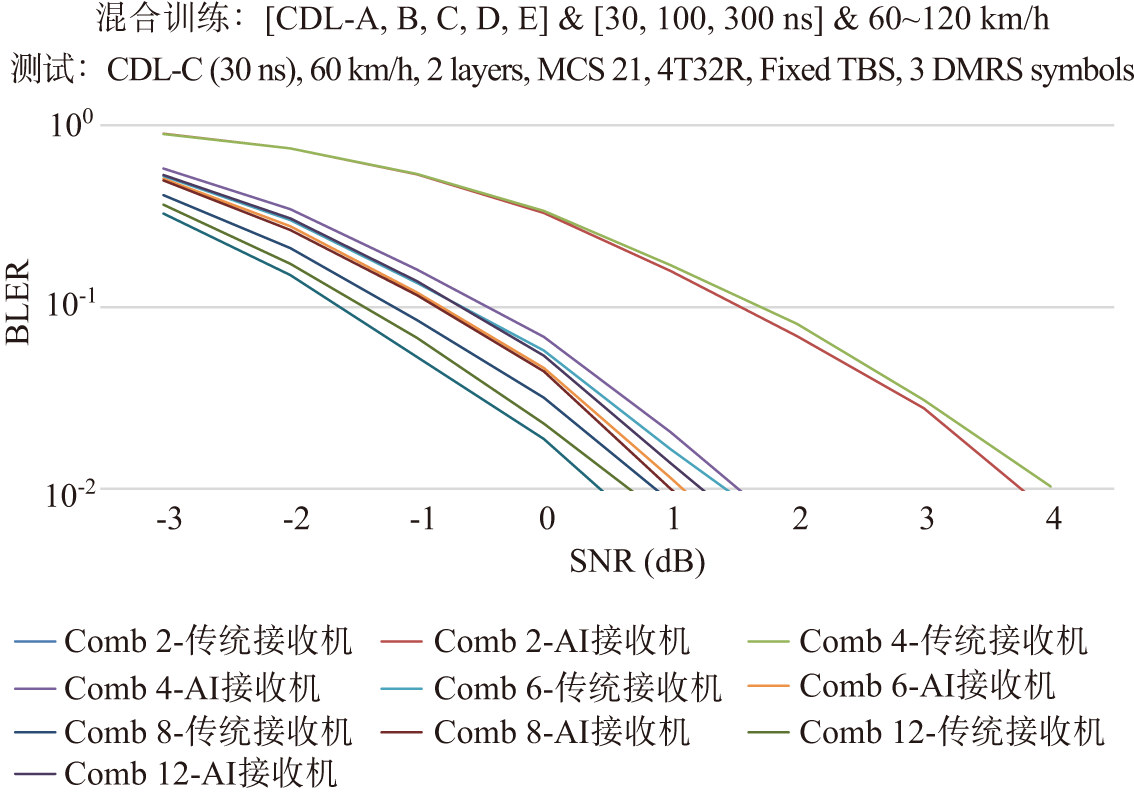
| 泛化策略 | 混合训练 信道类型:CDL{A, B, C, D, E} 时延拓展:{30, 100, 300 ns} 运动速度:0~30或60~120 km/h SNR:-20~0dB或-10~10dB MIMO层:{1, 2}层 | 混合训练 信道类型:UMi SNR:-20~0 dB或-10~10 dB MIMO层: {1, 2}层 调制方式:16QAM, 64QAM |
| [1] | 3GPP WG 1. Chair notes RAN1#122b[R/OL]. 2025. https://www.3gpp.org/ftp/tsg_ran/WG1_RL1/TSGR1_120b/Inbox/Chair_notes. |
| [2] |
Lagona L, Bockelmann C, et al. Transformer-based pilot-to-prediction for MIMO-OFDM systems[J]. IEEE Wireless Communications Letters, 2026, 15: 2333-2337.
doi: 10.1109/LWC.2026.3676796 URL |
| [3] | Liao X, He X, Zhang Z, et al. Channel estimation for MIMO-OFDM based on adaptive transformer network in high-speed mobile scenarios[J]. Journal of Electronics & Information Technology, 2026, 48(8): 3604-3615. |
| [4] | Qiao Z, Xue J, Zhang J, et al. Adaptive implicit-based deep learning channel estimation for 6G communications[J]. IEEE Communications Magazine, 2025, 63(8): 64-70. |
| [5] |
Huang C, Wang C X, Li J, et al. AI-driven 6G pervasive predictive wireless channel modeling for IEEE P1944 standardization: a comprehensive survey[J]. IEEE Journal of Selected Topics in Electromagnetics, Antennas and Propagation, 2026, 2: 255-275.
doi: 10.1109/JSTEAP.2026.3708808 URL |
| [6] | Ai B, Lu Y, Fang Y, et al. 6G-enabled smart railways[J]. Proceedings of the IEEE, 2026. |
| [7] | Watanabe T, Takigawa M, Ohseki T, et al. Unified channel estimation framework for flexible sparse DMRS patterns via transformer-based point cloud neural operator[C/OL]// Proceedings of the IEEE International Conference on Communications (ICC). 2026, 1-6. https://ieeexplore.ieee.org/abstract/document/11587829. |
| [8] |
Zhou X, Liang L, Ye H, et al. Reducing pilots in channel estimation with predictive foundation models[J]. IEEE Transactions on Communications, 2026, 74: 9360-9375.
doi: 10.1109/TCOMM.2026.3698937 URL |
| [9] |
Yamamoto H, Nakamura A, Uchida D, et al. Indoor experimental trial on AI-based pilotless transmission[J]. IEEE Access, 2026, 14: 64161-64170.
doi: 10.1109/ACCESS.2026.3684876 URL |
| [10] |
Ibarra-Hernández R F, Castillo-Soria F R, Gutiérrez C A, et al. Efficient deep learning-based detection scheme for MIMO communication systems[J]. Sensors, 2025, 25(3): 669.
doi: 10.3390/s25030669 URL |
| [11] | Daha M Y, Khurshid K, Ashraf M I, et al. Optimizing signal detection in MIMO systems: AI vs approximate and linear detectors[J]. IEEE Communications Letters, 2024, 10: 2387-239. |
| [12] | Mahmoud H, Mi D, Ismail T, et al. Enhanced performance of signal detection using deep learning approach in massive MIMO systems[C/OL]// Proceedings of the IEEE International Conference. 2025, 192-197. https://ieeexplore.ieee.org/document/11006798. |
| [13] | Ali A K, Shin J, Lim Y, et al. Explore advanced hybrid deep learning for enhanced wireless signal detection in 5G OFDM systems[J]. Computer Modeling in Engineering & Sciences, 2025, 145(3): 4245-4278. |
| [14] | Arslan M, Tong M S. An innovative neural network technique for MIMO systems: iterative decoding and channel estimation for optimal performance[C]// Proceedings of the Photonics & Electromagnetics Research Symposium (PIERS). 2025, 192-197. https://ieeexplore.ieee.org/document/11394038. |
| [15] |
Gansekoele A, Balatsoukas-Stimming A, et al. Joint demapping of QAM and APSK constellations using machine learning[J]. IEEE Open Journal of the Communications Society, 2025, 6: 1695-1709.
doi: 10.1109/OJCOMS.2025.3547261 URL |
| [16] | Hebbar S A, Ankireddy S K, Athi H, et al. Deep-OFDM: neural modulation for high mobility[PP/OL]. arXiv(2026-04-16)[2026-06-02]. https://arxiv.org/abs/2506.17530. |
| [17] |
Bray N, Hempel M, Sharif H. Towards fully DL-driven RF: a systematic survey of deep learning for wireless transceiver signal processing[J]. Applied Sciences, 2026, 16(4): 1878.
doi: 10.3390/app16041878 URL |
| [18] |
Roessler A, Lopez M M, Diab R, et al. AI/ML-driven 6G network solutions with energy efficiency considerations[J]. IEEE Access, 2026, 14: 39617-39645.
doi: 10.1109/ACCESS.2026.3666644 URL |
| [19] |
Doha S R, Abdelhadi A. Deep learning in wireless communication receivers: a survey[J]. IEEE Access, 2025, 13:113586-113605.
doi: 10.1109/ACCESS.2025.3584000 URL |
| [20] | Wiesmayr R, Cammerer S, Aït Aoudia F, et al. Design of a standard-compliant real-time neural receiver for 5G NR[C/OL]// Proceedings of the IEEE International Conference on Machine Learning for Communications and Networking (ICMLCN). 2025, 1-6. https://ieeexplore.ieee.org/abstract/document/11140048. |
| [21] |
Hashempoor H, Choi W. Deep learning-based data-assisted channel estimation and detection[J]. IEEE Transactions on Machine Learning in Communications and Networking, 2025, 3: 534-551.
doi: 10.1109/TMLCN.2025.3559472 URL |
| [22] |
Humse K K, Anjanappa C. Deep learning approaches for channel estimation and BER reduction in multipath fading OFDM systems[J]. SN Computer Science, 2025, 6(8): 930.
doi: 10.1007/s42979-025-04485-1 |
| [23] | 3GPP WG 1. Chair notes RAN1#125[R/OL]. 2026. https://www.3gpp.org/ftp/tsg_ran/WG1_RL1/TSGR1_125/Inbox/Chair_notes. |
| [24] | 3GPP TS 38. 901 Study on channel model for frequencies from 0.5 to 100 GHz V18.0.0[S/OL]. https://www.3gpp.org/ftp/Specs/archive/38_series/38.901. |
| [1] | WANG Yanmin, FENG Wei, DONG Chao, REN Baoquan, DUAN Xiangyang. Sensing-communication-computing-control closed loop for 6G unmanned operations: model, metric, and network design [J]. Information and Communications Technology and Policy, 2026, 52(9): 2-8. |
| [2] | LIU Guangyi, HE Zhimin, WANG Xinyao, CAI Qing, WANG Kaiyue, CHEN Tianjiao, JIN Jing. 6G communication-computing-intelligence convergence empowering embodied intelligence applications [J]. Information and Communications Technology and Policy, 2026, 52(9): 29-37. |
| [3] | KANG Shaoli, WANG Ke, QIN Haichao, FENG Yunjiu, WANG Dan, YANG Qixin. A study on use cases for low-altitude intelligent networked systems towards 6G [J]. Information and Communications Technology and Policy, 2026, 52(4): 2-14. |
| [4] | GUO Zhenming, CHEN Li, CHEN Feng. AI-empowered wireless positioning technologies in the 6G era [J]. Information and Communications Technology and Policy, 2026, 52(10): 16-25. |
| [5] | ZHANG Jing, WANG Huanli, CUI Can, LI Zhuofang, DU Liutong. Research on standardization progress of mutual empowerment between 6G networks and AI [J]. Information and Communications Technology and Policy, 2026, 52(10): 2-8. |
| [6] | XU Mingfeng, LI Yang, XU Weihua, ZHOU Jizhe, JIANG Jiamo. Key technologies, challenges and prospects for 6G enabled edge-end collaboration [J]. Information and Communications Technology and Policy, 2026, 52(10): 40-46. |
| [7] | LI Jiahui, SUN Yanran, LONG Biao. Multi-agent collaboration and AI capability lifecycle management architecture for 6G core networks [J]. Information and Communications Technology and Policy, 2026, 52(10): 47-54. |
| [8] | ZHOU Yihui, BAI Yuxuan, SUN Yuxuan. Study on federated continual learning algorithm for 6G mobile connected-vehicle scenarios [J]. Information and Communications Technology and Policy, 2026, 52(10): 55-63. |
| [9] | LIN Meiyu, XIE Jun, NIU Kai, LIU Ya, KOU Xiping, BAO Xinyi, JIAO Yang. Risk identification and research outlook for 6G network evolution [J]. Information and Communications Technology and Policy, 2026, 52(10): 64-71. |
| [10] | LI Qizhe, SUN Qianyi, LIU Chenji, YANG Wu, ZHU Guangxu. Current status, applications, and prospects of 6G wireless network intelligence driven by large models and agents [J]. Information and Communications Technology and Policy, 2026, 52(10): 72-79. |
| [11] | DU Liutong, LI Yang, WANG Huanli, LIU Yujuan, LI Zhuofang, DU Ying, XU Fei, ZHANG Jing. Research on development of mobile AI for 6G [J]. Information and Communications Technology and Policy, 2026, 52(10): 9-15. |
| [12] | ZHANG Enwan, ZHU Xunlin, WEI Lijing, ZHU Yunjie. Frontier exploration under hybrid computing architecture: application of quantum computing in 6G communications and future prospects [J]. Information and Communications Technology and Policy, 2025, 51(10): 31-39. |
| [13] | LU Dan, CUI Ying, HE Yizhou, HAN Wenting. Discussion on 6G security requirements and key technologies [J]. Information and Communications Technology and Policy, 2025, 51(1): 52-55. |
| [14] | CHENG Liwei, ZHANG Qian, LIANG Liyan, ZHOU Jie, YU Qingmin, HUANG Junjie. Demand for high-speed communication and related application scenarios of brain-computer interfaces [J]. Information and Communications Technology and Policy, 2024, 50(5): 12-17. |
| [15] | JIN Jing, WANG Yajuan, MA Liang, ZHANG Xiaozhou, DONG Jing, LIU Guangyi. Integrated sensing and communication for low-altitude network [J]. Information and Communications Technology and Policy, 2024, 50(11): 54-62. |
| Viewed | ||||||
|
Full text |
|
|||||
|
Abstract |
|
|||||
2020 © Information and Communications Technology and Policy
Address: 52 Huayuan North Road, Beijing, China Phone: 010-62300192 E-mail: ictp@caict.ac.cn
